
A large pharma company requested for a comprehensive assessment on two new drug targets of interest which are the most abundantly expressed inhibitory Leukocyte immunoglobulin (Ig)-like receptors. Read how Excelra's in-depth analysis helped the pharma company facilitate early discovery phase decisions.
Overview
Scientific informatics solutions are critical in early drug discovery for evaluating and prioritizing novel therapeutic targets with confidence. In this case study, Excelra applied advanced scientific informatics solutions to deliver a comprehensive comparative analysis of two putative drug targets, enabling a large pharmaceutical company to make informed early discovery decisions in immuno-oncology.
The engagement leveraged Excelra’s expertise in drug discovery informatics and integrated analytical frameworks to assess target biology, safety, druggability, and competitive landscape. This work aligns with Excelra’s broader capabilities in scientific informatics services and bioinformatics solutions.

Our client
The client is a US-based large pharmaceutical company operating in the immuno-oncology space. As part of its innovation strategy, the organization sought scientific informatics solutions to evaluate two highly expressed inhibitory Leukocyte immunoglobulin (Ig)-like receptors and determine their suitability as drug targets.
Excelra partnered with the client as a drug discovery informatics expert, supporting target evaluation through structured analytics and evidence-driven insights. This collaboration reflects Excelra’s experience in working with global biopharma organizations on complex R&D challenges.

Client’s challenge
The client required a holistic and comparative understanding of two novel immuno-oncology targets to de-risk early discovery investments. The challenge involved integrating diverse data types—ranging from molecular pharmacology and tissue expression to structural biology and safety data—into a single, coherent decision framework.
Such complexity demanded scientific informatics solutions capable of unifying biological, chemical, and clinical evidence. Excelra’s approach aligns with best practices discussed in its insights on leveraging legacy and current data in drug development and integrated data curation strategies.

Client’s goals
The primary goal was to enable confident early discovery phase decisions by:
- Characterizing the biological role of each target in healthy and disease states
- Comparing molecular pharmacology, expression profiles, and gene alterations
- Evaluating ON- and OFF-target safety risks
- Understanding the competitive landscape across discovery and clinical stages
Achieving these objectives required scientific informatics solutions that could transform fragmented datasets into actionable insights. Excelra’s strengths in data curation and scientific data management ensured analytical rigor and reproducibility.
Our approach
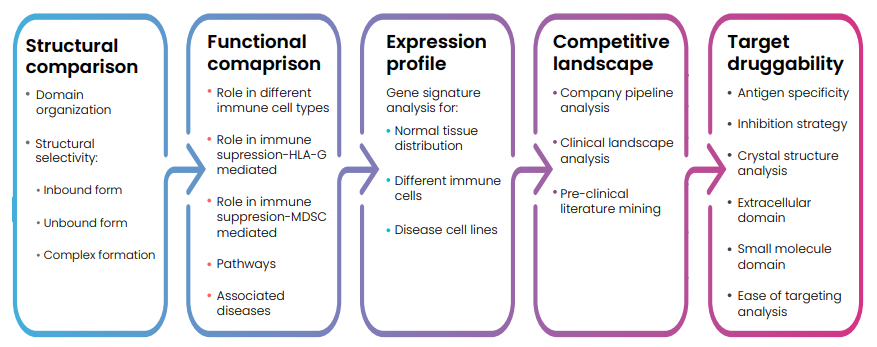
Excelra conducted a structured and multi-dimensional comparative analysis covering target function, disease association, molecular pharmacology, tissue expression, and target–protein interactions. Structural analyses included sequence evaluation, crystal structure assessment, domain organization, and homology modeling.
Through scientific informatics solutions, Excelra also performed competitor landscape analysis, safety de-risking assessments, and recommendations for animal models and pre-clinical assays. This approach combined Excelra’s Computational Biology Services with advanced scientific data management to deliver a comprehensive target dossier framework.

Conclusion
By applying scientific informatics solutions, Excelra delivered a holistic comparison of two putative immuno-oncology drug targets, clearly establishing their mechanisms of action and disease relevance. One target was recommended over the other as a first-in-class opportunity, supported by structural feasibility and lack of existing clinical competition.
This case study highlights how Excelra’s drug discovery informatics and computational biology services enable data-driven, de-risked decision-making at the earliest stages of pharmaceutical R&D.